
How many times have we seen the hold-down bolts being torqued by hand or by using pipes. There is a common misconception that more tight is always good. Our team recently had and a Generator set, we were called in to carry out vibration analysis and on-site balancing of the flywheel.
The challenge
- The first start-up of the machine showed very high vibrations, this was after major over-haul and bearing replacement of the entire set.
- The shafts were aligned using laser alignment kit and was well within the tolerances.
- Start-up vibration reached above 70 mm/s RMS, before reaching the full speed and was shut-down immediately to prevent any damage.
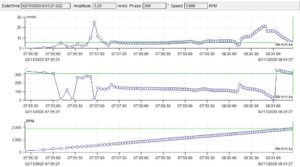
- As start-up data was taken during the run-up, the increase in amplitude and change in phase could clearly been seen. There was a critical speed very close to the full RPM.
- The critical speed combined with the un-balance prevented the machine from reaching its full RPM.
- The dominant vibration was on the Motor side. (Name of client crossed out to respect the confidentiality of the client)
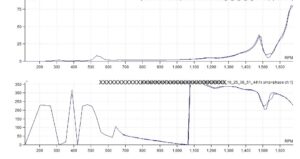
- A trial weight was added, based on in-complete data collected during the run-up. In the next run, machine had vibration of around 40 mm/s at critical speed. But was allowed to run till it reached the full RPM to check the vibration. At full speed, vibration was steady around 23 mm/s RMS (with weight)
- A balancing weight was calculated and reduced the critical speed vibration to around 22 mm/s and full speed RPM vibrations to 7 mm/s.
- The challenge was not over yet, when intermittent load was given to the Generator there is a speed drop for this specific machine. This would mean that the machine would constantly moving in and out of the critical speed zone.
- Bump Test result was carried out in different zones to study the natural frequencies.
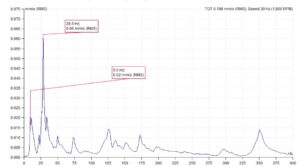
The hold-down bolts?
- The alignment was done within the limits, and soft-foot was checked to be within the tolerance. All hold-down bolts of the Motor was torqued with correct torque values.
- The vibration dampers/ mounting was changed during the maintenance.
- Since the tightening of this was not verified, all vibration damper hold-down bolts were loosened and re-torqued.
- Bump test was carried out again, which showed a reduction in the natural frequency.
- Natural frequency of the motor and frame shifted to 26 Hz, which increased the separation to 20%. This also ensured that machine, even when speed drops does not go into the critical speed zone.
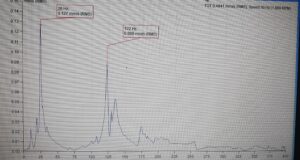
- Data was taken again, the machine now operates with maximum vibration of 4.5 mm/s RMS. Which is well below the OEM tolerance of 7 mm/s.
- A challenging balancing job, vibration troubleshooting was thus concluded successfully.
*Osborne Engineering provides dynamic balancing all across the Middle East and Europe. Including UAE, Poland, Oman, Bahrain, Kuwait, Saudi Arabia, Qatar.
#maintenance #fan #balancing #blower #vibration #training #analysis
